🚀 CODING ACCELERATION PROGRAM (90 DAYS)
Build Strong Foundations
Learn to Think Like a Programmer
Get Placement Ready
💡 Learn C Programming + Data Structures + Python from scratch with structured modules and practical coding approach.
📘 MODULE 1: FUNDAMENTALS OF COMPUTING
“Every great programmer starts with strong basics”
🔢 Number Systems
Binary | Decimal | Octal | Hexadecimal
→ Understand how computers represent and convert data
➕ Number Representation
Signed Magnitude | 1’s Complement | 2’s Complement
→ Learn how positive & negative numbers are stored in memory
🔤 Character Encoding
ASCII | Unicode
→ Decode how text, symbols & characters are processed by computers
💻 MODULE 2: INTRODUCTION TO C PROGRAMMING
“C is not just a language, it’s the foundation of programming logic”
📌 Introduction to C Language
→ Why C is powerful and widely used
📌 Structure of a C Program
→ Program organization and execution flow
📌 Character Set
Letters | Digits | Special Symbols
📌 Constants
Integer | Real | Character | String
📌 Keywords & Identifiers
📌 Variables & Memory Concept
📌 Data Types
int | float | char | double
📌 Operators
Arithmetic | Relational | Logical | Assignment | Increment/Decrement
💡 MODULE 3: CONTROL STATEMENTS IN C
“Build logic. Make decisions. Control the flow.”
🔀 Decision Making Statements
Simple if | if–else | nested if | if–else ladder
🔁 Looping Statements
for | while | do–while | nested loops
⏭️ Jumping Statements
break | continue | goto
🧠 MODULE 4: FUNCTIONS & PROGRAM STRUCTURE IN C
“Write smarter code with reusability and structure”
🔧 Functions in C
→ Block of code for specific tasks
📌 Types of Functions
Library | User-defined
📚 Standard Libraries
stdio.h | conio.h | math.h | ctype.h
⚙️ User-defined Functions
Declaration | Definition | Calling
📌 Function Types
No argument no return
Argument no return
Argument with return
No argument with return
📍 Variable Scope
Local | Global
🗂️ Storage Classes
auto | register | static | extern
🔁 Recursion
→ Base case | Recursive case | Call stack
📌 Problems: Factorial | Fibonacci | Number-based
📌 Recursion vs Iteration
⚡ MODULE 5: COMPLEXITY & EFFICIENCY
“Not just code… write smart and efficient code”
⏱️ Why Complexity?
→ Measure efficiency of a program
📊 Time Complexity
O(1) | O(n) | O(n²) | O(log n)
💾 Space Complexity
🔍 Analysis
Loop complexity | Statement complexity | Comparison
📊 MODULE 6: ARRAYS IN C
“Store more, manage better, code smarter”
📌 Introduction to Arrays
→ Same data type in contiguous memory
🔢 1D Arrays
Input | Output | Traversing
Programs: Sum | Average | Max | Min | Linear Search | Sorting
🧮 2D Arrays
Matrix representation
Programs: Addition | Subtraction | Multiplication | Transpose
📌 MODULE 7: STRING HANDLING IN C
“Work efficiently with text and character data”
📌 Introduction to Strings
→ Array of characters
📌 Declaration & Initialization
📌 Input / Output
📌 String Operations
Length | Copy | Concatenation | Comparison
📌 String Functions
strlen | strcpy | strcat | strcmp
📌 Applications
Text processing and validation
🔥 Key Focus:
✔ Strong string handling
✔ Practical manipulation skills
✔ Real-world usage
📌 MODULE 8: STRUCTURES & UNIONS
“Organize complex data in a structured way”
📌 Structures
Declaration | Initialization | Member access
📌 Array of Structures
📌 Nested Structures
📌 Unions
→ Memory-efficient storage
📌 Difference: Structure vs Union
🔥 Key Focus:
✔ Real-world data handling
✔ Efficient memory usage
✔ Strong programming foundation
📊 MODULE 9: SEARCHING & SORTING
“Organize data. Find faster. Think smarter.”
🔍 Searching
Linear | Binary
🔃 Sorting
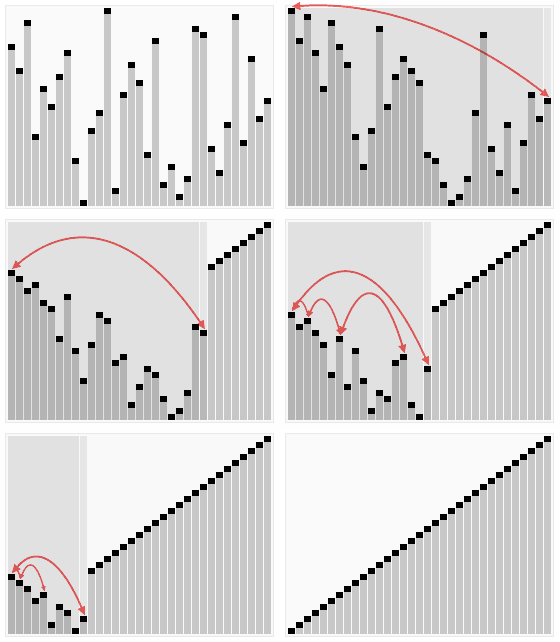
Bubble | Selection | Insertion | Merge | Quick
🎯 Key Outcomes
✔ Problem solving
✔ Efficiency understanding
✔ Interview readiness
🧩 MODULE 10: STACKS & QUEUES
“Control data flow like a pro”
📚 Stack (LIFO)
Push | Pop | Peek
🚶 Queue (FIFO)
Enqueue | Dequeue | Front | Rear
📌 Types
Simple Queue | Circular Queue
🔗 MODULE 11: LINKED LISTS
“Dynamic data structures for flexible memory management”
📌 Singly | Doubly | Circular
Operations
Traversal | Insertion | Deletion
🌳 MODULE 12: TREES & GRAPHS
“Master hierarchical and network data structures”
🌲 Trees
Binary Tree | BST
Traversals: Inorder | Preorder | Postorder
🌐 Graphs
Directed | Undirected | Weighted
Traversal: BFS | DFS
🐍 MODULE 13: INTRODUCTION TO PYTHON (PILOT STUDY)
“Step into modern programming with Python”
📌 Introduction to Python
→ Overview and applications
📌 Why Python?
→ Simple and widely used
📌 Basic Syntax
First program | Indentation
📌 Data Types
int | float | string | boolean
📌 Input / Output
📌 Operators
Arithmetic | Logical | Relational
📌 Control Statements
if–else | loops
🔥 Key Focus:
✔ Transition from C to Python
✔ Modern programming approach
✔ Multi-language confidence
⚡ “From C foundation to Python flexibility”
🎯 COURSE OUTCOME
✔ Strong programming foundation
✔ Logical thinking & problem solving
✔ Data Structures mastery
✔ Placement readiness
✔ Academic support for BCA / B.Tech / Diploma






 auxiliary


